
Mood-Based Content Discovery
Designing discovery systems for emotional intent and cognitive load
Role: Product designer (end-to-end)
Scope: Research · Interaction design · Prototyping · AI integration · Taxonomy exploration
Duration: 4 Weeks - Class project, November 2024
Platform: TV, OTT
Design tools: Figma, Fathom, Chat GPT, Google docs, Zoom
Problem
People often open content platforms knowing how they feel, but not what they want to watch or engage with.
Most discovery systems optimize for:
Past behavior
Popularity
Genre or category structure
These approaches work when intent is explicit, but break down when users are:
Emotionally driven
Mentally fatigued
Looking for something that “fits the moment”
As a result, discovery becomes effortful and repetitive instead of supportive.
Netflix users often know how they want to feel, but not what they want to watch. Traditional search and genre filters force users to translate emotions into titles, increasing decision fatigue and time to play.
Allowing users to explicitly express mood would improve content discovery, reduce friction, and increase exploration compared to keyword or genre-based search alone.
Challenge: How might we reduce cognitive and emotional friction in content discovery when intent is mood-driven rather than explicit?

Research and insight
I explored how people describe content discovery during low-energy or emotionally driven moments through interviews and exploratory research.
After synthesizing findings, one core insight emerged: When cognitive load is high, users think in moods, not categories.
Three patterns consistently surfaced:
Emotional intent precedes content intent: Users could describe how they felt before knowing what they wanted.
Too many options increase friction: Large catalogs created anxiety instead of clarity.
Discovery should feel supportive, not demanding: Users wanted guidance without having to articulate precise preferences.
This reframed discovery as an emotional alignment problem, not a search problem.
Emotional intent is easier for users to express than content intent. When mood options are visible and embedded into familiar navigation patterns, users explore more confidently and with less friction.


Design principles
Based on the insights, I defined three guiding principles:
Emotion-first entry: Let users start from how they feel, not what they want.
Low-effort interaction: Minimize typing, filtering, and comparison.
Guided clarity: Provide just enough structure to move users forward confidently.
These principles informed all downstream design decisions.
Solution
I designed a mood-based discovery experience that translates emotional input into relevant content suggestions (referencing Apple TV).
Key product decisions included:
Mood selection as the primary entry point, rather than search or genre
Curated content groupings aligned to emotional states
Progressive refinement, allowing adjustment without restarting or overwhelming the user
The system was intentionally lightweight and optimized for moments of low energy or decision fatigue.
Core experience
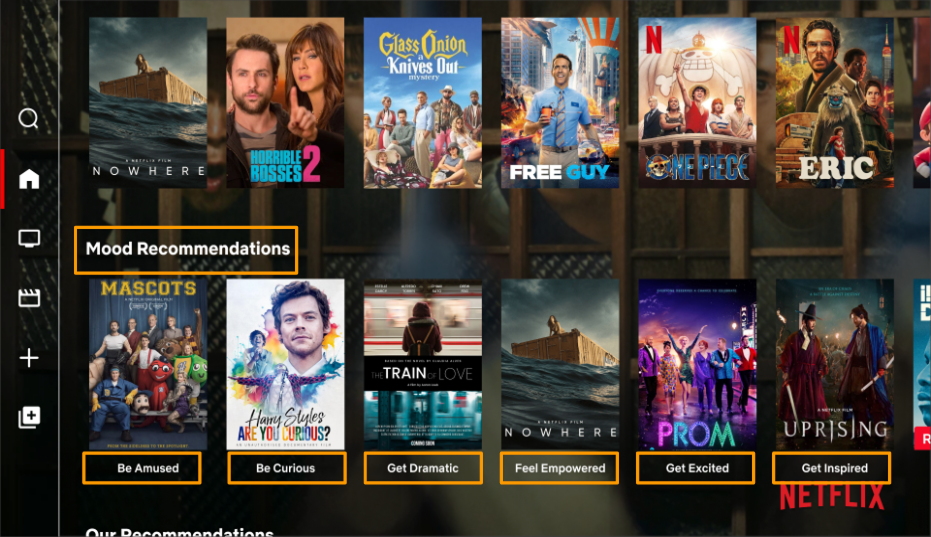
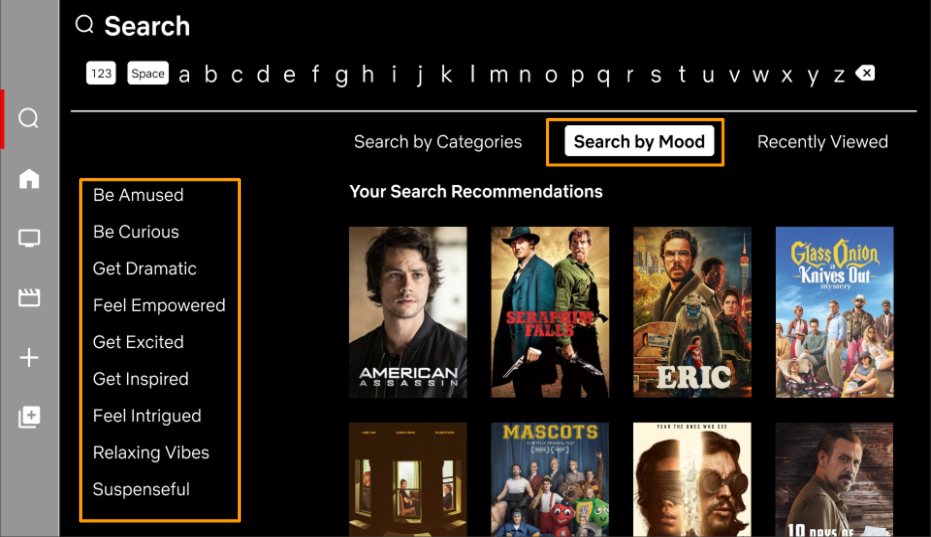
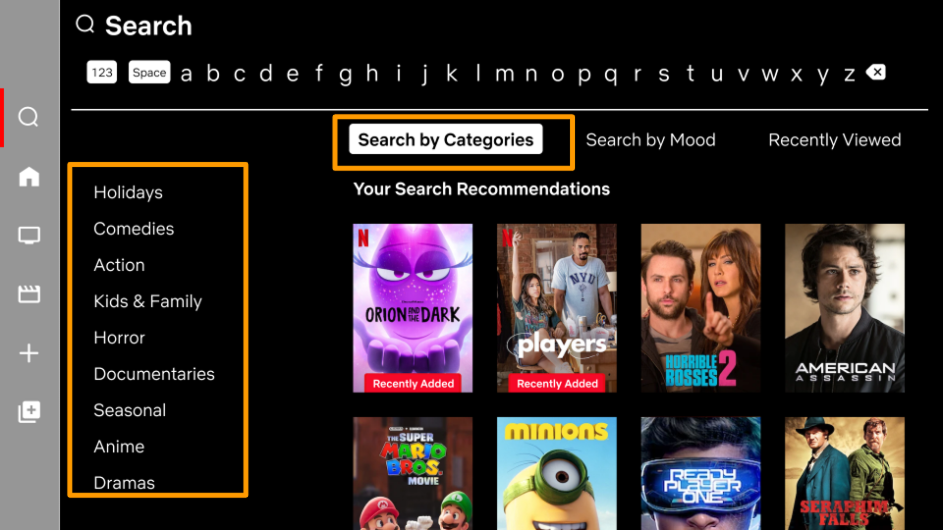
I introduced “Search by Mood” as a first-class filter alongside existing categories
Added mood-based recommendation rows on the Home screen to support passive discovery
Renamed and refined mood categories to feel emotionally relatable rather than abstract
Ensured visual and interaction parity with Netflix’s existing UI to reduce cognitive load
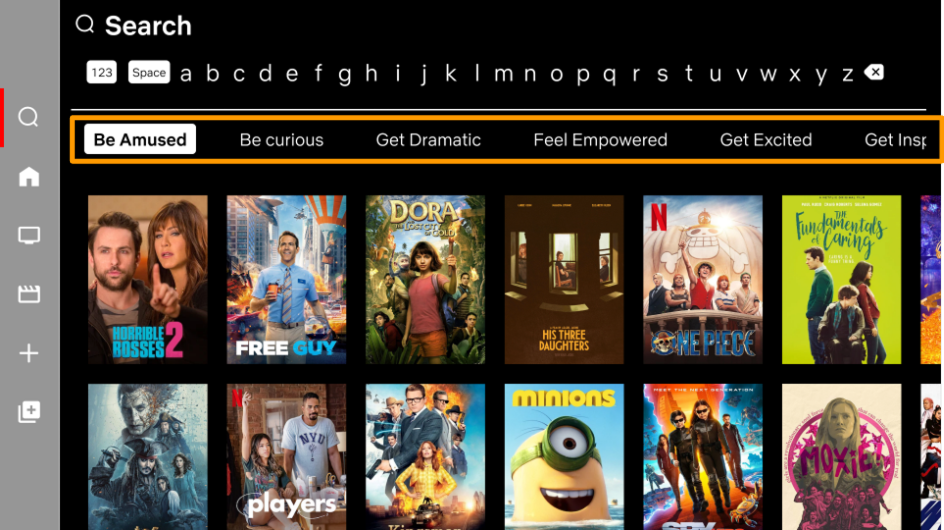
The core flow supports three stages:
Express a current mood with minimal effort
Receive content aligned to that emotional state
Refine or explore without cognitive overload
Validating the hypothesis
I evaluated early concepts through usability walkthroughs, focusing on:
Speed to relevant content
Perceived emotional alignment
Points of hesitation or confusion
Iterations prioritized reducing friction while maintaining clarity and control.


Outcomes
This exploratory work validated a key hypothesis that, Aligning discovery with emotional intent improves relevance and decision confidence.
Early feedback indicated:
Faster time to content selection
Reduced frustration during browsing
Higher perceived relevance of recommendations
While conceptual, this work strengthened my approach to designing for emotional context and cognitive load at scale.
Users reported finding content faster when searching by mood.
The feature increased satisfaction by making recommendations feel personal and relevant.
Highlighted the value of personalization beyond viewing history.
What Didn’t Fully Work
Mood labels were interpreted differently across users
Some categories felt ambiguous or overlapping
Users wanted clearer personalization signals tied to their viewing history


Impact
This concept demonstrates how emotionally-driven inputs can reduce decision fatigue, improve discovery, and complement algorithmic recommendations without disrupting established user behavior.
I finished this project in November 2024 and Netflix released a similar direction that later appeared in-market, which reinforced the problem framing, in April 2025.
Reflection
Mood-based discovery works best when paired with adaptive personalization.
Future iterations should refine mood taxonomy and clarify category intent
Opportunity to leverage Netflix’s recommendation algorithms to dynamically adjust mood relevance per user.
Feature can scale across platforms while maintaining ecosystem consistency
Clarity matters: Mood labels need to be intuitive for users to trust them.
Multiple entry points help adoption: Placing the feature in search and on the home screen gave users more confidence in finding it (across most streaming platforms).
Feedback loops improve design: Iterating on vague mood categories showed me the importance of refining language with user input.
Next Steps
If developed further,
Explore AI and contextual signals (like time of day or weather) for deeper personalization.
Expand testing to more diverse user groups.
Explore how mood signals adapt over time without overfitting.
Test integration with existing recommendation systems.
Measure impact on session satisfaction and engagement quality.