
YouTube Web Usability Study
Identifying friction in cross-platform mental models and interaction consistency
Role: UX Researcher (moderated testing, synthesis, insight development)
Scope: Research design · Facilitation · Analysis
Team: 3 researchers
Duration: 1 week - Group project, April 2025
Participants: 16 Survey respondents, 4 moderated sessions
Platform: YouTube web app
Overview
YouTube’s web platform supports high engagement, but inconsistencies between web and mobile experiences may introduce friction in task execution.
Survey data showed:
69% use YouTube daily
75% primarily access via desktop
44% manage playlists
Despite high familiarity, friction persisted in core flows.
Research question: Where do experienced users encounter breakdowns in clarity, consistency, or feedback on the YouTube web app?
Research objectives
Identify gaps across core features: search, playlists, subscriptions, and navigation then, recommend improvements aligned with Neilson’s usability principles.
Assess how easily users could find and watch content on their primary devices.
Evaluate learnability and memorability of features, especially rarely used ones.
Observe errors during navigation and propose improvements.
Measure efficiency in completing tasks like playlist management and subscriptions.
Gather qualitative feedback to understand user reactions and frustrations.
Synthesis
While overall task success was high, the research revealed:
Mental models built on mobile do not always transfer to web
Taxonomy misalignment increases cognitive load
Lack of confirmation erodes trust in destructive actions
High familiarity does not eliminate friction
Methodology
We conducted:
We selected 4 diverse participants (ranging from casual viewers to advanced users (students, educators, and creators) for moderated remote usability session (30-40 min. each)
Tasks evaluated:
Search and subscription flows
Playlist creation and deletion
Public playlist discovery
Shorts discovery and sharing
Watch history access
Homepage return navigation
We measured:
Task completion
Time on task
Error patterns
Memorability
Qualitative friction signals
Overall task completion rate: 90.6% . We captured both quantitative metrics and qualitative feedback, analyzing the results to uncover themes.
Key insights
Friction emerged not from lack of usability, but from inconsistency in system behavior and labeling.
Three major breakdown patterns surfaced:
Cross-Platform Inconsistency (Major): 75% of participants noted inconsistencies between web and mobile experiences
Playlist Discoverability Breakdown (Major): 50% of participants were unable to successfully find public playlists
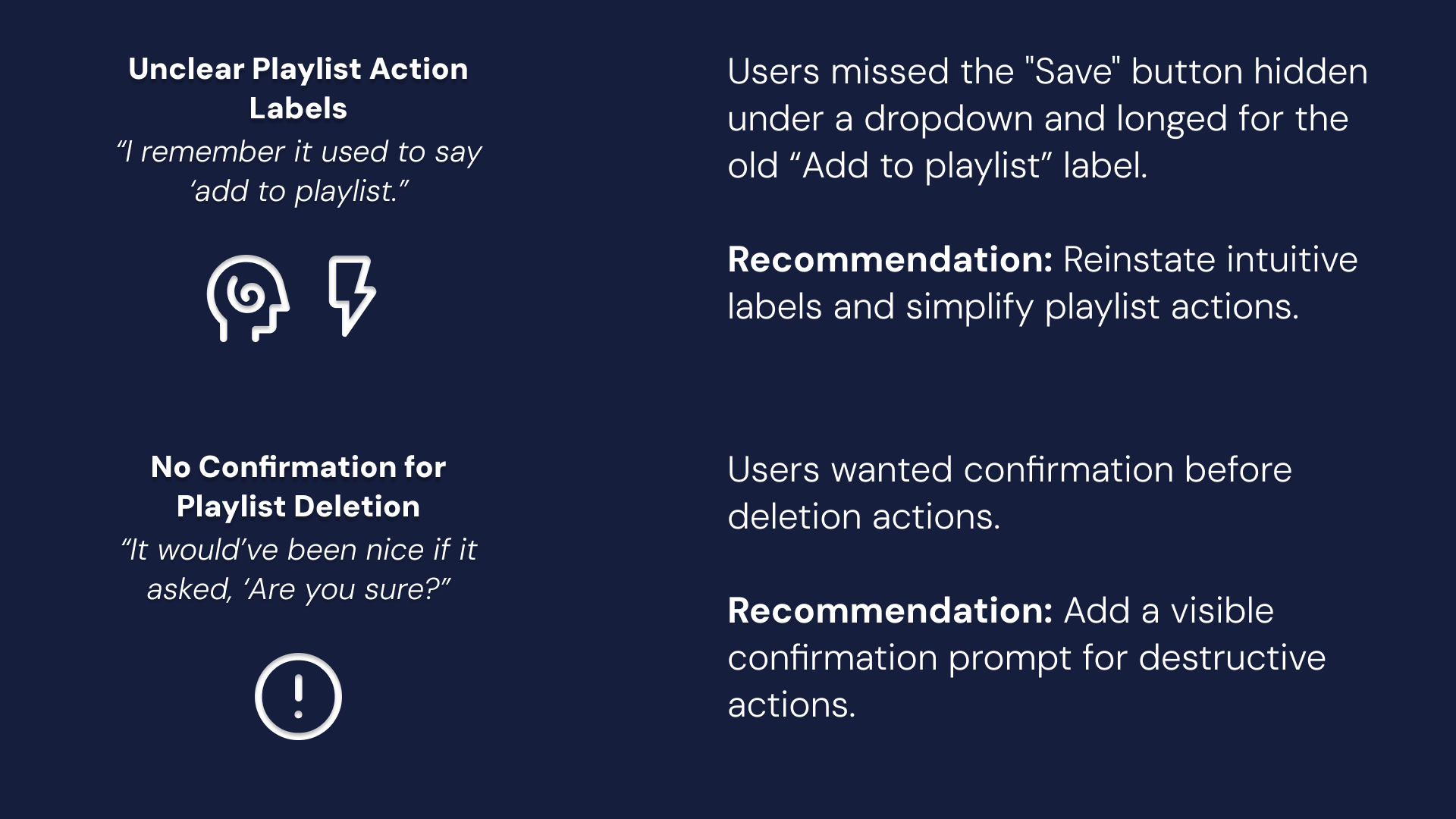
Feedback & Label Clarity (Major): Users struggled with - “Add to playlist” labeling changes, Lack of confirmation before deletion


My role
My focus was moving from task metrics to mechanism-level insight.
Co-developed the research plan and screener
Facilitated moderated sessions
Translated behavioral observations into structured insights
Identified cross-platform inconsistency as the primary systemic theme
Recommendations
Our recommendations focused on clarity, guidance, and consistency:
Redesign playlist icons and labels to improve discoverability.
Provide lightweight onboarding or visual cues for Shorts to help users understand the feature.
Add confirmation messages for deletions to reduce user hesitation and errors.
Ensure consistency in features and interface patterns across desktop and mobile to build user trust.
Impact and reflection
The study revealed that even a platform as familiar as YouTube presents usability challenges that impact daily engagement. Small adjustments like clearer labels or timely feedback, can meaningfully improve confidence and efficiency for users.
For me, this project reinforced the value of structured usability testing. I learned how to scope research quickly, analyze data thematically, and translate findings into actionable design opportunities. It also strengthened my ability to collaborate with peers and communicate insights in a way that balances both user needs and product goals.
This project challenged me to apply structured research methods within a tight timeline while communicating insights in a way that could guide product and design decisions.